بِسْمِ ٱللَّٰهِ ٱلرَّحْمَٰنِ ٱلرَّحِيمِ
In the Name of Allah, the Merciful, the Compassionate
When fast change conflicts with slow maintenance
It’s apparent that over the last few years, there’s been an increase in Muslim-led efforts towards “social change”. These efforts focus on issues across many aspects of life: social, political, economic, technological, etc.
I’ve observed that it’s common for many Muslims to treat the social change they’re invested in as urgent, because they feel it’s a priority. Multiply this by the volume of Muslim communities doing the same thing with a wide-range of topics here in Ontario, and you end up with a noisy landscape filled with actors competing for attention, donations, actions, and so on. While “urgent” actions have a legitimate place, Ontario Muslim leaders can take caution in absorbing this default setting when it comes to enacting these efforts.
There’s many issues that come from being in a perpetual state of “urgency”. But the one I want to draw attention to is the disruption caused by mixing the two lanes: the (legitimately) fast-urgent and the (understandably) slow-important.
I aim to offer some strategic benefits for accurately identifying the pace of the change Muslim community leaders work on and how to navigate potential conflict when there’s misalignment.
A system’s natural pace via Stewart Brand’s “Pace Layering”
Stewart Brand’s concept of “Pace Layering” has its roots in architecture, but is widely appreciated by the design and foresight-adjacent communities. For many practitioners in these fields, Pace Layers offer a useful way to add in the time dimension to a systems-level change.
The key insight to this framework is simple and yet underappreciated: the different layers of a system inherently move at different paces. To illustrate, Stewart Brand outlines the layers of a civilizational system, with nature being the slowest and fashion being the fastest.
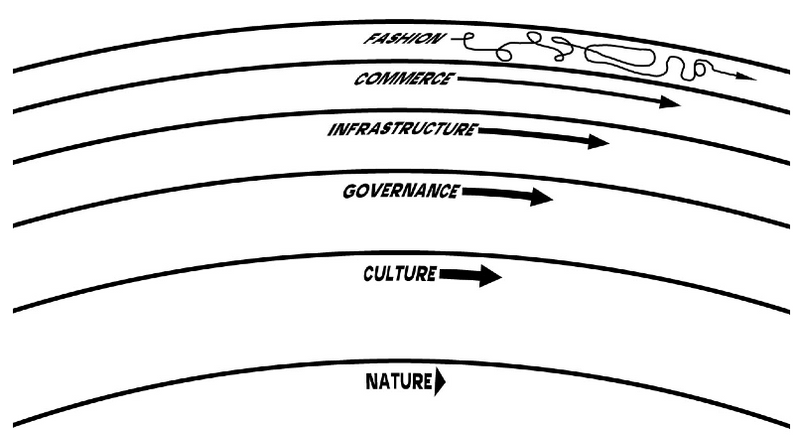
Fast learns, slow remembers. Fast proposes, slow disposes. Fast is discontinuous, slow is continuous. Fast and small instructs slow and big by accrued innovation and by occasional revolution. Slow and big controls small and fast by constraint and constancy. Fast gets all our attention, slow has all the power.
All durable dynamic systems have this sort of structure. It is what makes them adaptable and robust.
Now we might not have to take Brand’s concept of a healthy civilization as true from an Islamic worldview. What I’m pointing attention to are the strategic benefits of thinking in Pace Layers. Perhaps the profoundness of this thinking comes when you invert the takeaway: you cannot enact change at your preferred pace, if the nature of the system doesn’t allow it. You cannot speed up the growth of a child. You attend to them, nurture them, and support their natural pace of growth.
Strategic considerations drawn from Pace Layers for Ontario’s Muslim Community Leaders
Thinking in Pace Layers can offer a useful way for framing the variety of pathways towards short and long-term changes that Muslim communities act on simultaneously. It can help understand the benefits and limitations of different tactics deployed. For example, protests and petitions towards a foreign policy vs. maintenance and upkeep of local social cohesion.
Some key strategic considerations emerge from this mode of thinking. I’ll present them in question format:
- What is the inherent “pace” of the work you’re doing? Even social systems have a pace they move by and change by. Within that, there are more or less favourable times to initiate a change in a political system, an education system, a cultural system, etc.
- Do other Muslim community members (stakeholders) agree with and appreciate your identification of the “pace”? Conflict arises when the preferred, and actual pace is perceived differently by stakeholders of the issue. This is especially so when those desiring change and those enacting it perceive the pace differently.
- What issues might come up when a pace is misunderstood by community members/stakeholders? Essentially this becomes a matter of clarifying priorities. What happens to the stakeholder support/buy-in when they feel a priority should be moved up or moved down?
- What other layers does your/ your organization’s work consist of? And what are the paces of those layers? There are real limits to the number of activities any system (ex: organization, group, individual) can manage, so capacity becomes an honest strategic perspective to take in.
- What other pace layers are moving concurrently in the environment (i.e. other Muslim communities)? Does the work in the environment at that same pace help or hinder your efforts?
One can work through many of the questions above by “reordering” the pace layers with stakeholders involved. This requires an understanding and appreciation of the reasonings for a determined pace and then negotiating commitments and actions towards the reordering. So this tool is also helpful to negotiate through the conflicts that emerge when the paces bump into each other.
The ‘Adab’ أدب of mutual respect towards other Muslims’ pace of change
The metaphor on the general direction of qibla comes to mind. According to some madhabs, facing the direction of prayer only requires some portion of the face to be directed towards the Ka’ba. So as long as one is within 180 degrees, they’re considered praying in the same direction.
We can then appreciate that there are many Muslim communities in Ontario who are trying to improve their conditions and the conditions of Canadian society overall. They are generally facing the same direction, or at least don’t have their backs fully towards one another. And we can appreciate that according to their perception, they’re allocating the pace of work according to their perception and understanding of the issue.
So the ‘Adab’ (knowing the right pace of things) is for all actors to recognize that their fellow Muslim community leaders and members are working towards similar ends, but at different paces. If you’re inclined to work at a fast and urgent pace, then understand that the mode of tactics you use may not resonate with everyone. Therefore the attitude of a “with us or against us” is unproductive overall, and worse, it limits the possibilities of collaboration (Islamic-bounded pragmatism, see here). And inversely, if you’re working at a slow pace, you have to acknowledge that those tactics may only appeal to those who appreciate, and have the luxury to take on, the long-view.
This statement by the Assunnah Muslim Association (AMA) in Ottawa presents a fine example of how to educate stakeholders on a slower pace of work, against the demands of a faster pace, while appeasing them for greater good.
A disproportionate focus on the fast-attention at the expense of the slow-powerful
I must admit that recently, I’ve noticed the fast pace gets the bulk of the attention, energy, and even funding for social change amongst Muslim community leaders in Ontario. I would caution that the investment of energy and resources should be in proportion to the impact of the layer.
Take for example government-supported funds of a mosque’s security. This can be considered as a fast pace when the mosque has been attacked/has a real risk of attack and security measures are needed. However, it’s important to not lose sight of the investments and time it takes to foster strong relations with the mosque’s neighbours, local community, and the overall societal cohesion over time. These help contribute to a mosque’s safety at a slower pace, but at a more powerful and enduring pace. There’s also a second-order benefit: in this example, right-sizing the efforts to the slower pace helps prevent Muslim communities’ slippery slope towards relying on technocratic solutions for their issues. This mode of depending on legal, political, and technological solutions to social issues is increasingly becoming disconnected and disfavoured by a growing number of Canadians.
The challenge of juggling work across multiple time horizons
Working across multiple time horizons at the same time is no easy task. From an organizational strategy perspective, this requires constant tracking of the external environment, the internal operations, and the multiple objectives to meet, while the entire landscape is in chaotic, unpredictable motion.
The key to trying to do this successfully is to be honest about the energy and resources you have available to work simultaneously on the layers, over time. Arguably, the slower, important layers should have a substantial and enduring commitment. While the fast and urgent have their allocation. It would perhaps even be wise to have some buffer and slack to account for the unpredictable.
الله أعلم
Allah knows best